
How Resilient Leaders Lead with Intentional Continuity, Speed, and Trust
Build, manage, and grow your big
thing with Sketch To Growth™️!
The Resilience Playbook
Let’s be honest – every company has at least one person who, if they disappeared tomorrow, would bring progress to a crawl. Worst, you have more than one.
? Maybe it’s the engineer who built the foundational model that underpins the entire platform.
? Maybe it’s the ops lead who knows every quirk of a fragile supplier integration.
? Maybe it’s the COO who still holds the logic for three “temporary” systems no one else fully understands.
Leaders either acknowledge this risk or pretend it doesn’t exist. The smart ones plan for it.
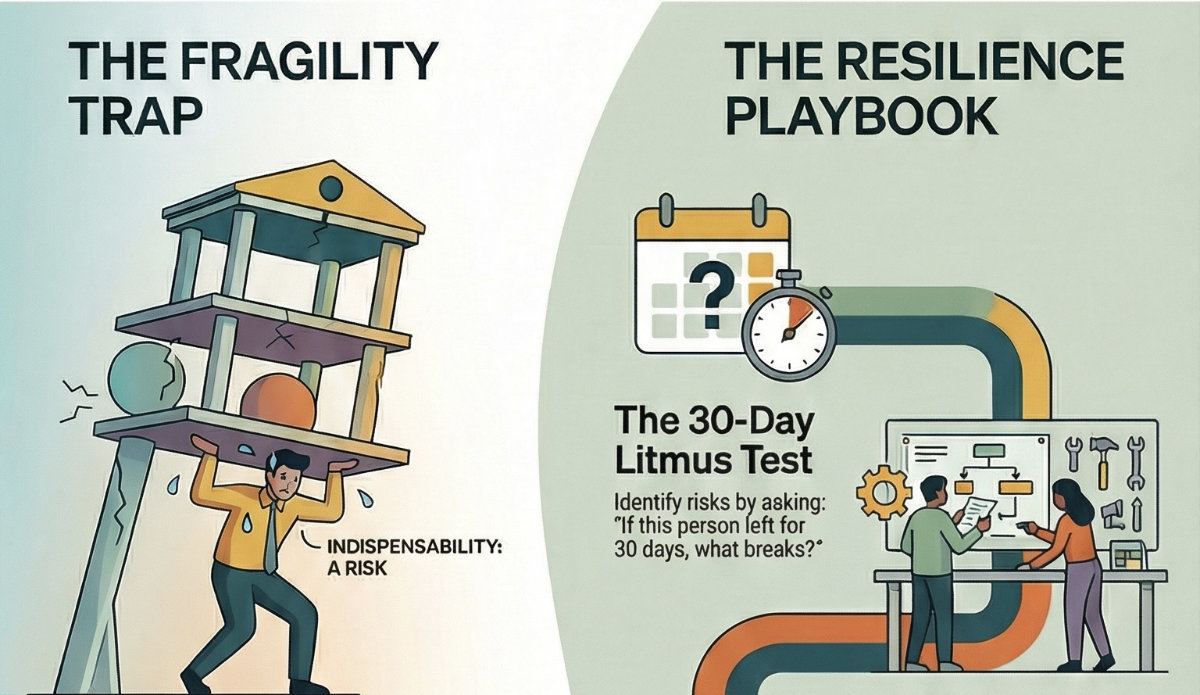
The real issue isn’t dependence – it’s fragility. As a founder or CEO, you can’t afford to pause shipping, fundraising, or customer delivery because critical knowledge walked out the door. Resilience isn’t pessimism. It’s governance.
Think of it as building fire exits for your intellectual capital.
Why Single Points of Knowledge Failure Are So Dangerous
Single points of failure rarely announce themselves. They hide inside success.
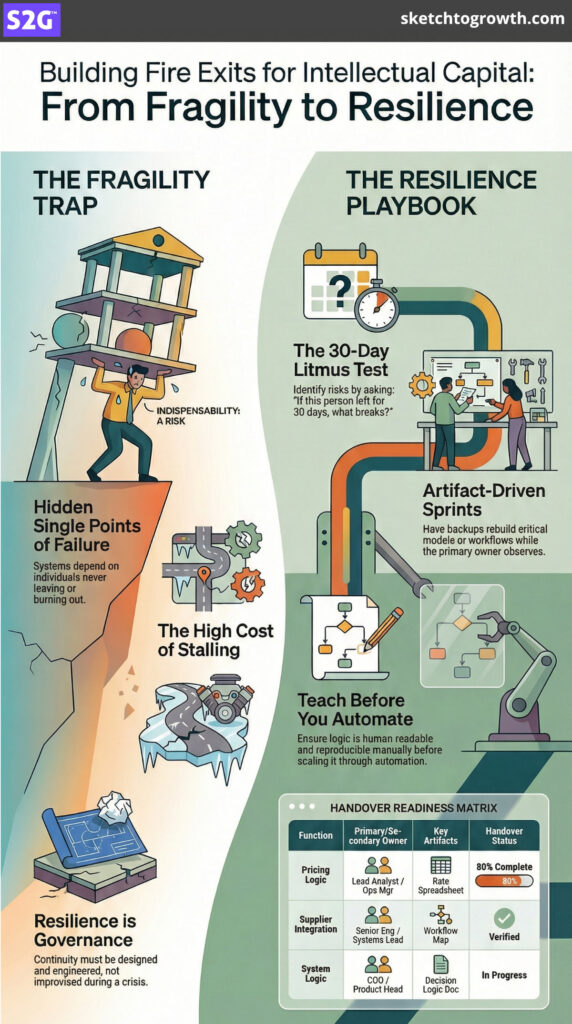
Early speed rewards heroics. One person moves fast, fixes everything, and becomes indispensable. Over time, that indispensability turns into risk. Not because the person is doing something wrong – but because the system depends on them not leaving, not burning out, and not getting hit by real life.
Research from MIT Sloan on organizational resilience consistently shows that firms with distributed knowledge and clear ownership recover faster from disruption than those reliant on informal expertise. The reason is simple: continuity is designed, not improvised.
The cost of fragility shows up everywhere:
- Roadmaps stall when a key contributor leaves
- Deals slip because no one can explain edge-case pricing
- Engineering teams freeze rather than risk breaking something they don’t understand
- Investors lose confidence long before revenue declines
This is not a talent problem. It’s a systems problem.
Key Idea #1: Design for Continuity, Not Heroics
Resilient organizations plan for transitions before they’re forced to react to them.
That starts with identifying where knowledge lives with one person and asking an uncomfortable question: If this person stepped away for 30 days, what breaks?
From there, the fix is straightforward:
- Identify critical workflows and decision logic
- Capture them in a canonical artifact (not scattered docs)
- Assign a real secondary owner – not a name on paper, but someone capable of execution
A practical example
We’ve seen teams run a two-to-three day knowledge-transfer sprint for critical domains. The primary owner walks backups through the real artifact – a rate spreadsheet, forecasting model, or workflow map. Then the backups rebuild it themselves while the primary observes. QA follows.
The benefit:
- Hidden assumptions surface immediately
- Knowledge transfers through action, not explanation
- The organization gains redundancy without bureaucracy
This approach mirrors principles used in high-reliability organizations (like aviation and healthcare), where simulation and replication outperform documentation alone.
It’s intense. It’s efficient. And it’s far cheaper than learning under fire.
Key Idea #2: Treat Business Logic as a Business Function
This is where many technology-forward companies quietly sabotage their own speed.
Too often, teams insist that every rule, threshold, or policy live inside code. Engineers become accidental business analysts. Business leaders wait in Jira queues to change logic they understand better than anyone.
We’ve seen this movie before. It’s slow, expensive, and unnecessary.
When logic is fundamentally about business policy – pricing rules, rate structures, approval workflows – ownership should sit with the domain that understands the why, not just the how.
What changes when ownership is clear
- Business teams iterate faster without engineering bottlenecks
- Engineers focus on stability, performance, and security
- Decision-making becomes traceable and accountable
- Fewer “urgent” tickets clog the backlog
This approach aligns with modern product org thinking, where role-first design assigns accountability before implementation. Marty Cagan has written extensively about this in the context of empowered product teams – clarity of ownership is what enables speed, not process.
A simple role-mapping matrix helps anchor this:
- Function
- Primary owner
- Secondary owner
- Key artifacts
- Handover status
It’s unglamorous. It works. And it scales far better than tribal knowledge and Slack archaeology.
Key Idea #3: Teach Before You Automate
Before you reach for sophisticated tooling, make sure the logic can be explained simply.
Spreadsheets get mocked, but they persist for a reason – they’re transparent. Rows and columns force clarity. They expose assumptions. They make cause and effect visible.
Before automating any complex process:
- Break it into human-readable steps
- Ensure multiple people can reproduce it manually
- Identify where judgment, not rules, actually applies
This principle shows up repeatedly in lean systems thinking and in Toyota’s approach to process design: standardize the work before you optimize the system.
Why this matters
Automation amplifies whatever it touches. If the logic is unclear, automation just scales confusion faster.
A practical rule we recommend: require business owners to implement their process manually before it goes into production tooling. Learning by building beats learning by theory – and it exposes flaws while fixes are still cheap.
Manual first is not slow. Rework is.
The Bigger Idea: Resilience Is a Competitive Advantage
Operational resilience isn’t defensive management. It’s offense.
In a market where talent moves quickly and reputations turn overnight, the real moat is repeatability when your stars leave. The most dangerous sentence in any organization is, “Ask Brielle – she know’s how that works.”
The job of leadership isn’t to hoard brilliance. It’s to systematize it.
Companies that do this well:
- Reward teaching, not just execution
- Make handovers routine, not reactive
- Test “what if” scenarios quarterly – if this person left, what breaks?
- Treat documentation as a growth asset, not overhead
This is consistent with findings from McKinsey’s work on organizational health, which shows that role clarity and accountability outperform incentives alone when it comes to sustained performance.
Make it boring. That’s how it works.
The Playbook, Condensed
- Identify single points of knowledge failure
- Assign real backups, not symbolic ones
- Run short, artifact-driven knowledge transfers
- Let business teams own business logic
- Teach first, automate second
Do this consistently and continuity stops being accidental – it becomes engineered.
The best-performing companies we work with obsess over documentation and role clarity the same way they obsess over product-market fit. Because when your organization can absorb loss without collapse, you stop playing defense and start building offense.
So ask yourself: what knowledge, if lost tomorrow, would freeze your next launch?
Start there.
Build redundancy. Document relentlessly. Share early.
Resilient teams don’t fear transitions – they practice for them.
That’s the difference between fragile brilliance and lasting impact.